
Introduction
Is Arabic one of the hardest languages to learn?
It is commonly rumored that learning Arabic is difficult and arduous, but this belief is not entirely accurate.
For although Arabic is a language rich in vocabulary as well as grammatical, morphological, and rhetorical structures, it can be learned easily by adopting effective strategies, just like any foreign language.
In this article, we will discuss the key challenges prospective Arabic learners may face and present practical solutions to overcome them.
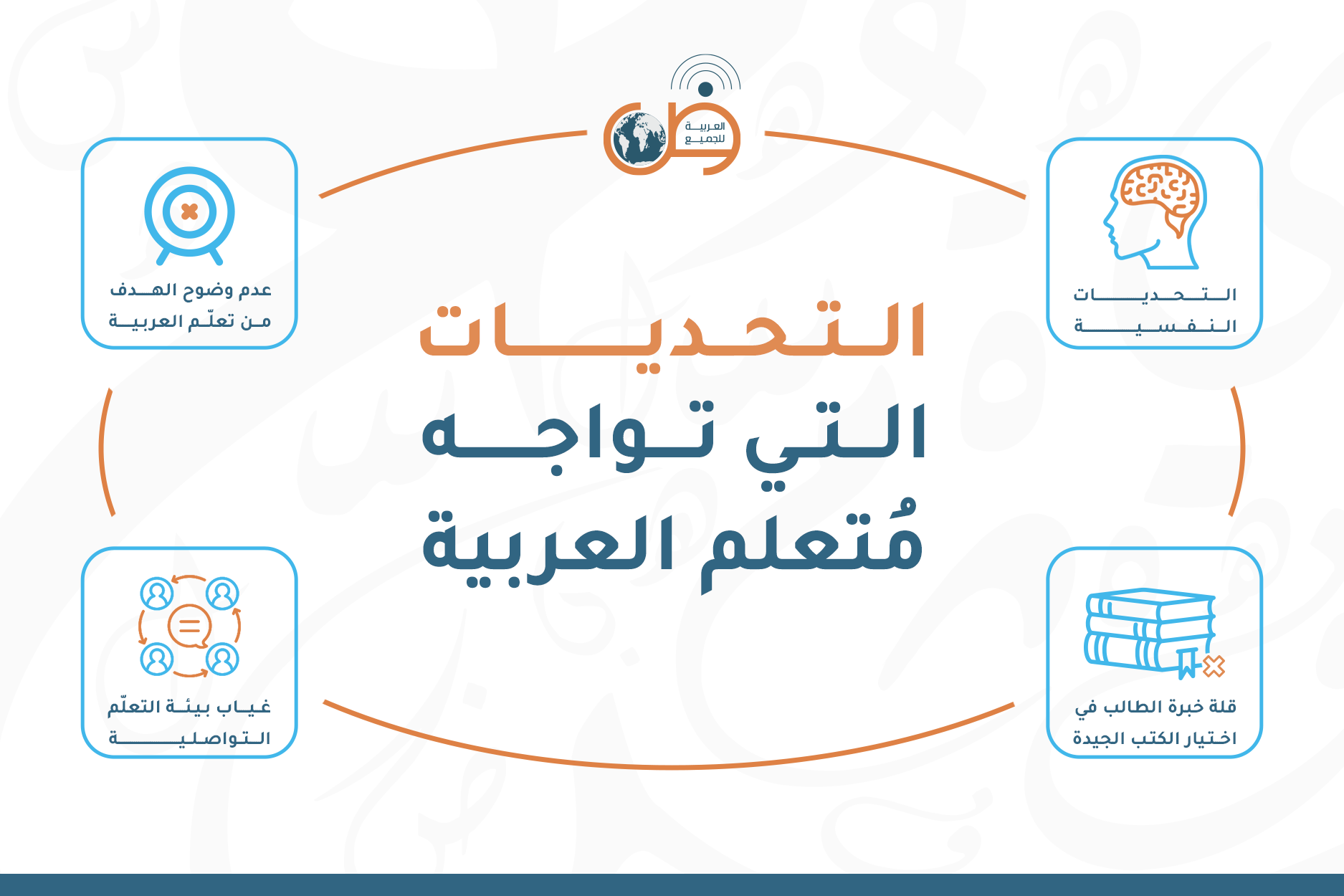
Challenges Facing the Arabic Learner.
First: Psychological challenges:
Such as the fear of failure. Some students may fear failing to learn Arabic, which dampens their resolve. Learners may also occasionally feel frustrated by their slow progress in learning the language, especially given the abundance of vocabulary and structures. This is natural across all languages and is subject to the learning method used and the learner's individual learning style.
Second: Lack of clarity regarding the goal of learning Arabic:
Some students may lack a clear goal for learning Arabic, which causes the learning process to lose its drive and its focus on what is truly beneficial.
Third: The student's lack of experience in choosing good books:
Amid the vast abundance of books and educational materials available for learning Arabic, learners may face difficulty in choosing a good book that meets their needs, helps them achieve their goals, and accommodates their proficiency level.
Fourth: The absence of a communicative learning environment:
Learning Arabic requires a communicative educational environment that enables learners to converse with others and practice language skills. This often necessitates traveling to Arab countries, which may not be feasible for everyone; however, there are alternative avenues to traveling that can be followed.
Appropriate Strategies for Learning Arabic:
If you have identified some of the challenges in learning Arabic, know that you have taken the first step on the learning journey. A true learner sees in these challenges opportunities for understanding and innovation, and a natural step on the path of learning and discovering effective solutions.
Now, let us share with you the most essential strategies to assist in learning Arabic, summarized in the following points:
- Overcoming fear:
Remember that all learners face difficulties at the beginning of their journey. Do not be ashamed of making mistakes, as they are part of the learning process.
- Drawing inspiration from success stories:
Learn about the experiences of people who have succeeded in learning Arabic, and benefit from their insights and advice.
- Focusing on Standard Arabic (al-Fusha):
It serves as the foundation for understanding Arabic across all Arab countries and acts as a gateway to learning the various colloquial dialects.
- Choosing a comprehensive curriculum:
One that combines the teaching of grammar and vocabulary, while focusing on common linguistic structures.
- Seeking the help of a specialized teacher:
A specialized teacher helps you understand Arabic better, corrects your language errors, and develops your communicative language.
- Creating an Arabic learning environment:
Such as establishing a micro-Arabic environment within the country of study itself, finding a language partner, and communicating with Arabic speakers online through various mediums—and there is no harm in traveling to an Arab country if feasible.
- Define your goal in learning Arabic:
Knowing your goal—whether for trade, tourism, or understanding religious matters—provides greater clarity and facilitates the process of selecting common vocabulary and structures used in communication.
Conclusion
Finally, remember that learning any language requires patience and perseverance. Do not give up easily, and continue your journey until you achieve your goal of mastering the language.